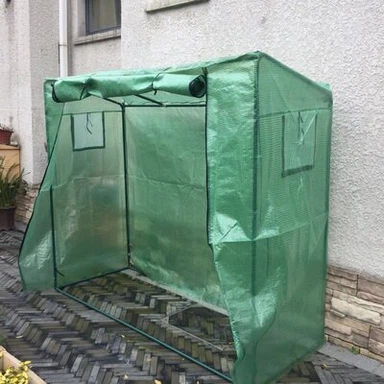
Mini Polytunnel Buying Guide For Retailers
Aug 14, 2026
For retailers, wholesalers, distributors, and garden product importers, choosing a mini polytunnel is not simply a matter of comparing unit prices or selecting the smallest available greenhouse.
A mini polytunnel has to work at several levels.
It needs to fit the space available to the end customer, provide a suitable growing environment, offer a reasonable balance between strength and cost, arrive in good condition, and be simple enough for the customer to assemble. At the same time, the specification needs to make commercial sense for the retailer, from SKU planning and container loading to after-sales support.
This is why two mini polytunnels with similar dimensions can perform very differently in the market.
A good buying decision starts with the structure behind the product, not the marketing name on the packaging.
This guide explains the key factors retailers should evaluate when sourcing mini polytunnels, including dimensions, frame specifications, cover materials, ventilation, anchoring, assembly, packaging, SKU strategy, and supplier selection.
Define Your Target Customer Before Choosing a Mini Polytunnel
The first step is not choosing a tube diameter or cover material.
It is identifying the customer you want the product to serve.
Mini polytunnels are generally positioned between very lightweight portable greenhouses and larger permanent greenhouse structures. Their appeal comes from providing protected growing space without requiring the footprint or investment of a large greenhouse. More broadly, the USDA Natural Resources Conservation Service describes high tunnels as covered structures that protect crops from conditions such as sun, wind, excessive rainfall, and cold while helping extend the growing season. See the USDA NRCS High Tunnel Initiative.
Typical target customers may include:
- Gardeners with limited outdoor space
- Allotment users
- Backyard growers
- First-time greenhouse buyers
- Customers who want to extend the growing season
- Gardeners who need a compact structure for vegetables, herbs, flowers, or seedlings
However, these customers do not all need the same specification.
A customer with a very narrow backyard may prioritize width over total growing area. A customer with more outdoor space may prefer a longer structure. A buyer in a warm climate may place more emphasis on ventilation, while a buyer in a cooler climate may prioritize cover performance and wind resistance.
For retailers, the first procurement question should therefore be:
What problem is this mini polytunnel solving for my target market?
Once that is clear, the appropriate dimensions and specification become much easier to determine.
Choose the Right Width and Length
One of the most important decisions is the relationship between width, length, and available installation space.
A wider greenhouse provides more usable internal space, but width also increases the amount of garden area required. For customers with narrow gardens or restricted side access, a compact width can be more attractive even when the customer wants a relatively long growing area.
A 6ft-wide format, for example, is approximately 2m wide. This makes it suitable for markets where customers want more growing space without moving into the footprint of a larger professional tunnel.
Length then becomes the main variable.
Retailers can use different lengths to create separate product tiers without completely changing the underlying structure.
A practical SKU structure could include:
Short: compact models for very small gardens and entry-level customers.
Medium: the main volume-selling size for general gardening applications.
Long: higher-capacity models for customers who have enough space but still want a relatively narrow footprint.
This approach is often more commercially efficient than offering many completely different greenhouse designs.
Compare Frame Specifications Properly
Frame construction has a direct influence on durability, assembly, cost, and perceived product quality.
However, comparing frames is not as simple as looking for the largest tube diameter.
At minimum, retailers should compare four elements:
Tube diameter
A larger diameter generally provides a larger structural section, but the actual performance also depends on wall thickness, steel properties, hoop spacing, connections, and anchoring.

Wall thickness
Wall thickness affects the amount of steel used in the tube and can influence resistance to deformation.
For this reason, a supplier should provide a specification such as:
32mm × 1.0mm
rather than simply stating:
32mm galvanized tube
Hoop spacing
The distance between hoops affects the way the structure distributes loads.
A frame with the same tube specification but different hoop spacing may perform differently under wind or snow loads.
Connection design
The connection between hoops, horizontal members, door frames, and ground supports is also important.
A strong tube alone does not guarantee a strong structure. Weak connections can become the limiting factor.
For procurement, the most useful practice is to request a complete frame drawing or specification sheet rather than relying on a product title such as "heavy duty" or "reinforced."
Compare Frame Specifications Properly
"Galvanized steel" is a useful starting point, but it does not describe the complete quality of the frame.
Retailers should ask suppliers for more detailed information about the material and corrosion protection.
Questions worth asking include:
- What steel specification is being used?
- What type of galvanization is applied?
- What is the stated coating specification?
- Is the material galvanized before or after forming?
- How are cut and punched areas treated?
- What inspection is carried out on incoming tubes?
Why Galvanized Steel Frame Greenhouse Are Better?
These details matter because a mini polytunnel is an outdoor product. The frame is exposed to moisture, temperature changes, condensation, and other environmental conditions throughout its service life.
For B2B buyers, another useful point is consistency.
Even if the first sample looks good, the supplier should be capable of maintaining the same tube dimensions, wall thickness, and corrosion protection across production batches.
This is particularly important when the same product will be sold under a retailer's own brand.
Evaluate the Cover as a Separate Product Component
The cover is often treated as a secondary part of the greenhouse, but in practice it is one of the most important components.
A retailer should not compare covers using only film thickness or GSM.
Instead, evaluate:
Material: What type of PE or PE-based film is used?
UV resistance: What protection is built into the film, and what service life is expected under outdoor exposure?
Light transmission: Is the film intended for general gardening, propagation, or a more specific growing environment?
Tear resistance: How likely is the material to resist damage during installation and normal use?
Condensation management: Does the film offer anti-drip or condensation-control properties?
Expected service life: Is the stated lifespan realistic for the target market and climate?
The most important point is that cover life should be treated as part of the product specification, not as an afterthought.
A retailer selling a low-cost structure with a very short-lived cover may receive more complaints than a retailer selling a slightly more expensive structure with a better-performing film.
This is why it can make commercial sense to offer multiple cover grades within the same product family.
Door Design Should Match the Product Positioning
A door is more than an entrance.
It affects accessibility, ventilation, packaging, assembly, and the user's overall perception of the greenhouse.
Retailers should compare:
- Door width
- Door height
- Door type
- Number of doors
- Door frame construction
- Opening mechanism
- Relationship between door design and ventilation
For a compact 6ft-wide structure, the door should provide practical access without taking up an excessive amount of usable space.
A narrow opening may reduce usability. An unnecessarily large or complicated door may increase product cost without providing meaningful value for the target customer.
The best solution depends on the product's intended market position.
Do Not Treat Anchoring as an Accessory
Anchoring is one of the easiest parts of a mini polytunnel to underestimate.
The frame may be strong, but an outdoor structure still depends on a suitable connection to the ground.
Retail buyers should therefore ask:
- What type of anchors are included?
- How many are supplied?
- How are the hoops connected to the ground?
- How is the cover secured at the bottom?
- Are additional anchoring options available?
- What installation method is recommended?
For example, burying the cover edge can provide a different level of fixation compared with simply placing weights along the edge.
The supplier should also provide clear installation instructions.
This matters because customers may incorrectly assume that the greenhouse can be secured in the same way as a lightweight walk-in greenhouse.
A strong anchoring system combined with clear installation guidance can reduce avoidable complaints and improve the end-user experience.

Assembly Complexity Is a Retail Issue
Retailers sometimes evaluate assembly from the factory's perspective rather than the customer's perspective.
A product can be easy to manufacture but difficult to assemble.
Before approving a mini polytunnel, consider whether the end user can realistically understand and complete the installation.
Useful features include:
- Clearly identified tubes
- Consistent component dimensions
- Pre-punched connection points
- Standardized fasteners
- Complete accessory sets
- Logical frame assembly
- Clear diagrams
- Easy-to-follow cover installation instructions
A sample should ideally be assembled before a large order is confirmed.
This reveals problems that may not be visible in a factory quotation.
For example, the retailer may discover that:
- Two tubes look almost identical but are different lengths
- Small hardware is difficult to identify
- The cover requires several people to install
- The instructions do not match the actual components
- The door assembly is more complicated than expected
These details matter because every installation problem eventually becomes a customer service issue.
Packaging Can Influence Your Real Cost
For a wholesale buyer, packaging is part of the product.
A mini polytunnel contains long steel tubes, a relatively large cover, multiple connectors, anchors, and many small accessories. If these components are poorly organized or insufficiently protected, the risk of damage and missing parts increases.
Retailers should evaluate:
Protection: Are the frame tubes protected against damage during transport?
Organization: Are small components grouped logically?
Completeness: Is every component required for installation included?
Package size: Is the carton or bundle suitable for storage and delivery?
Retail presentation: Does the packaging look appropriate for the target market?
Container efficiency: How many sets can be loaded into a container without compromising product protection?
Container loading deserves special attention for B2B buyers.
A product that costs slightly less per unit may not actually be more competitive if it uses significantly more shipping volume.
The better comparison is:
Landed cost per sellable unit
rather than simply:
Factory price per unit
Think About SKU Strategy Before You Place the First Order
One of the biggest mistakes in product sourcing is ordering multiple sizes before understanding which differences customers actually value.
A better approach is to identify a small number of meaningful product variables.
For mini polytunnels, these may include:
- Length
- Frame specification
- Cover grade
- Door configuration
- Ventilation
- Accessory package
These variables can be used to create clear product tiers.
Entry-Level
Designed for customers who mainly want affordable protected growing space.
Typical priorities:
- Compact size
- Standard galvanized frame
- Standard PE cover
- Basic access
- Essential anchoring
Mid-Range
Designed for the largest mainstream customer segment.
Typical priorities:
- Improved frame specification
- Better cover performance
- More practical ventilation
- Stronger anchoring
- Better overall user experience
Premium
Designed for experienced gardeners or customers prioritizing durability and convenience.
Typical priorities:
- Heavier frame
- Higher-performance cover
- More ventilation options
- Improved accessibility
- Upgraded accessories
This creates a much clearer price architecture than offering many unrelated products.
Customers can understand why one model costs more than another, and retailers can manage inventory more efficiently.
Test the Product Before Scaling the Order
A supplier sample should be treated as a procurement test, not just a visual sample.
Before approving mass production, retailers should evaluate:
Structure
Does the frame feel sufficiently rigid for its intended market.
Components
Are all tubes and accessories present and clearly identifiable?
Assembly
How many people are required?
How long does installation realistically take?
Cover
Is the film easy to install?
Does it fit correctly?
Are there weak points around doors and corners?
Anchoring
Are the supplied anchors appropriate for the intended installation?
Packaging
Can the product survive normal handling and transport?
Instructions
Can someone unfamiliar with the product follow the manual without additional explanation?
Testing these points before the first large order is usually much cheaper than discovering the same problems after several containers have been distributed.
A Practical 6ft-Wide Mini Polytunnel Example
For retailers evaluating this category, a 6ft wide mini polytunnel is a useful format to consider because it provides a relatively narrow footprint while allowing different lengths and specifications to be developed around the same basic product concept.
One practical example is the 6ft polytunnel from DELITE, which is based on a 2m-wide structure. Its listed configurations include different lengths, tube specifications, cover materials, door options, and ventilation choices, allowing the same basic 6ft-wide concept to be adapted for different market positions.
For example, the published range includes 32mm frame tubing with wall thicknesses from 0.8mm to 1.2mm, PE tri-layer and PE-EVA cover options, different door configurations, and optional ventilation features.
The purpose of looking at a real product example is not to suggest that one specification is suitable for every market. Instead, it provides a useful reference for applying the procurement criteria discussed in this guide.
Need a Custom Mini Polytunnel Specification?
Different markets may require different lengths, frame specifications, cover materials, ventilation systems, or packaging formats.
Explore the Full Polytunnel Greenhouse Range
Mini Polytunnel FAQ
What width is best for a mini polytunnel?
There is no single ideal width for every market. A 6ft-wide structure is a practical option for retailers targeting customers with limited garden space because it provides useful growing capacity without requiring the footprint of a wider commercial tunnel. The best width should be determined by the installation space, customer profile, transport limitations, and intended product positioning.
Is a 6ft-wide polytunnel suitable for retail products?
Yes. A 6ft-wide polytunnel can work well as part of a retail greenhouse range because the relatively narrow footprint makes it suitable for compact gardens while allowing different lengths and specifications to create multiple SKUs.
What frame specifications should retailers compare when choosing a mini polytunnel?
At minimum, compare tube diameter, wall thickness, hoop spacing, steel specification, galvanization, and connection design.
Is assembly difficulty important when choosing a supplier?
Yes. Assembly complexity can directly affect customer satisfaction, returns, reviews, and after-sales workload. A sample should ideally be assembled before bulk production to verify component identification, hardware completeness, instructions, cover installation, and overall installation time.